1 .... The Actual Weekend Scenarios

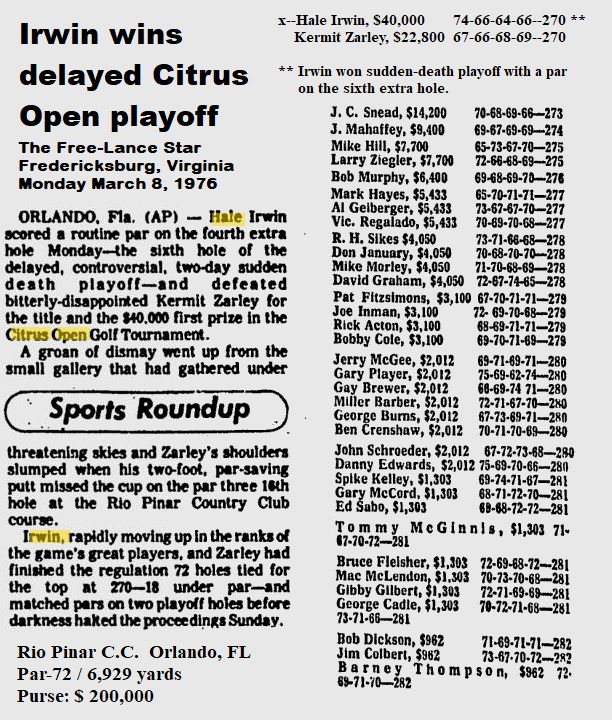
 Actual 36-hole cut,          82 professionals at even-par-144 or better
 using Low-70 and ties ...... 20 pros alone at even-par-144, tied for 63rd

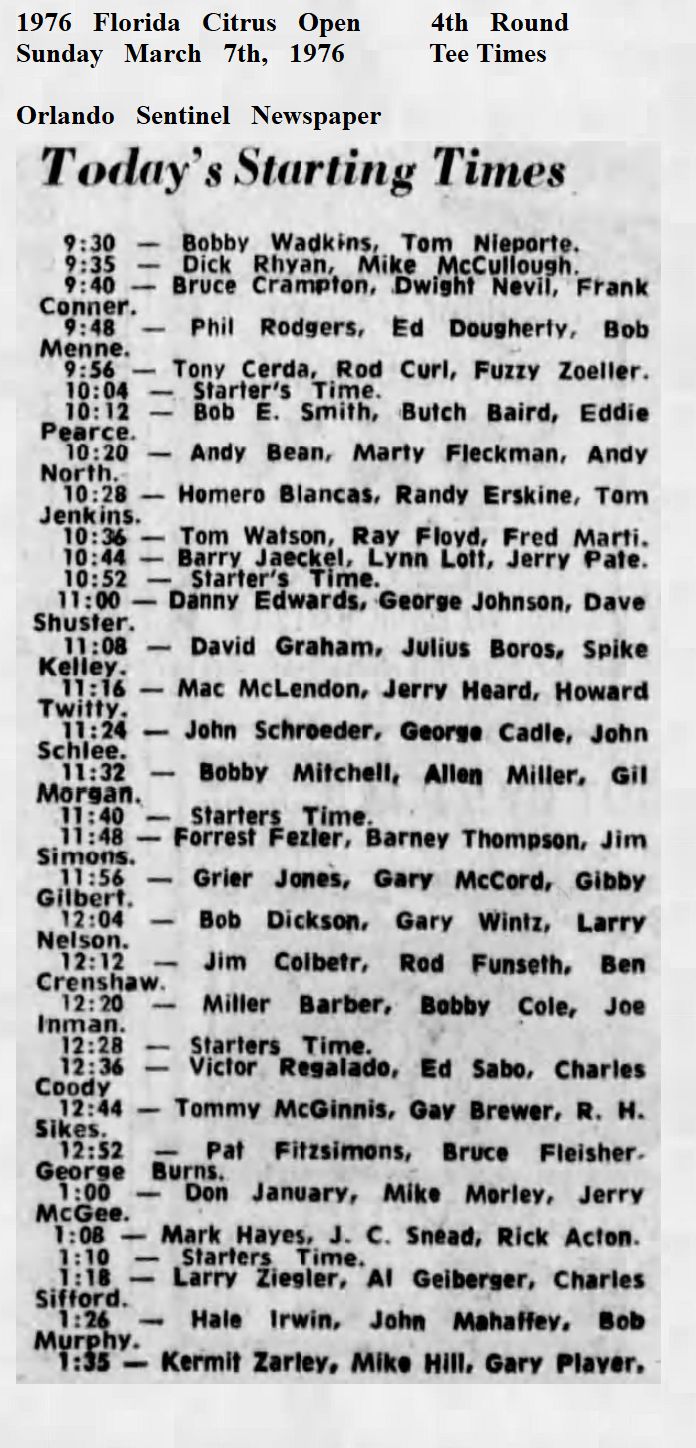
 In Saturday's third round, it is assumed that the field of 82 pros was assigned
 to play in 26 threesome groups, plus two twosome groups, with all groups going
 off from the first tee.

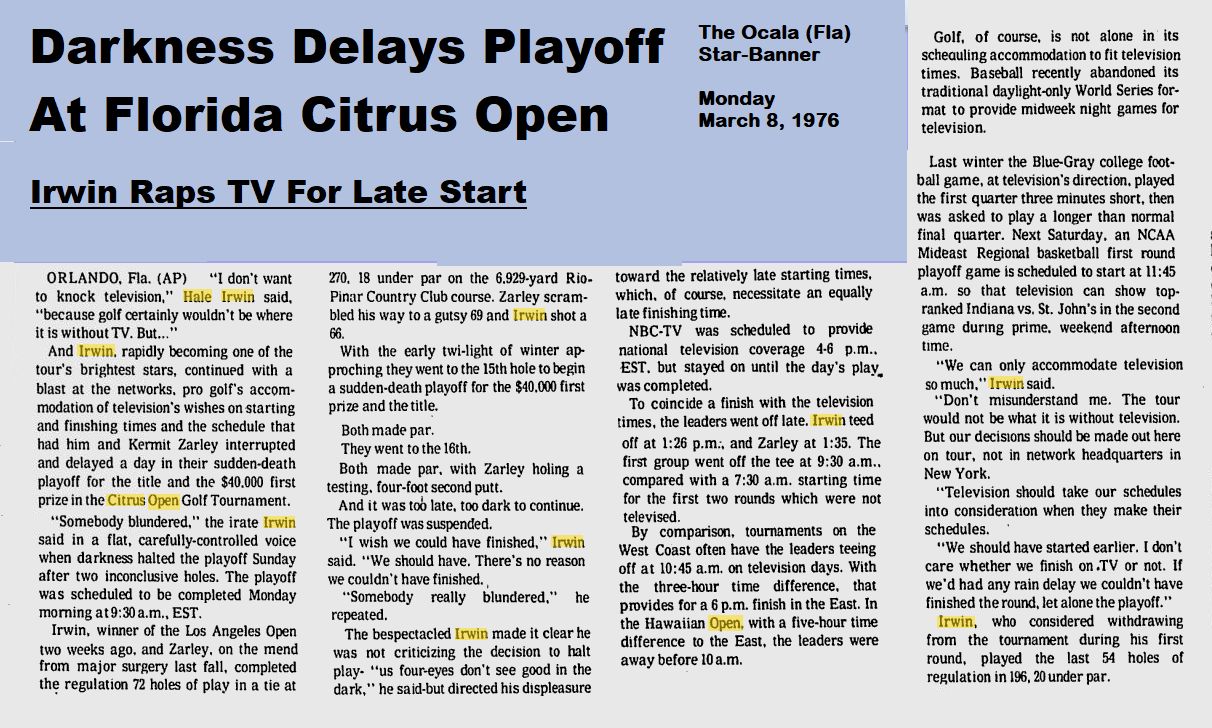
 One pro, Julius Boros, withdrew prior to the start of the 4th round, reducing
 the Sunday field to 81. Boros' withdrawal came -AFTER- the Sunday tee times
 were released to the press. That original schedule is shown above. Unless
 otherwise, it is assumed that the other two members of Boros' group played
 on their own.

2 .... Hypothetical Sunday Scenarios, using a Double Cut

 Hypothetical 36-hole cut,    82 professionals at even-par-144 or better
 first using                  13 pros alone at 1-under-143, tied for 50th
 Low 72 and ties ............ 20 pros alone at even-par-144, tied for 63rd

 Next using                   62 professionals at 1-under-143 or better
 Low 50 and ties ............ 13 pros alone at 1-under-143, tied for 50th

 NOTE .. Among those who would -NOT- have advanced to the final 36 holes in
         this hypothetical scenario were (actual finish) .. R.H. Sikes (tied
         11th), Gary Player (tied 19th, fired 62 in 3rd round), Danny Edwards
         (tied 19th) and Julius Boros (withdrew before the fourth round).

         The Double Cut rule provides for those 20 pros not advancing to the
         final 36 holes to receive appropriate prize money and finish credit,
         something that was not the norm for the Tour at that time.

         Furthermore, any pro who made the Low 50 cut, but was then unable to go
         on and finish out the full 72 holes -- regardless of reason -- would
         have their status reverted to that of Low 72 and ties, and would
         receive appropriate money and finish credit.

 NOTE -- Low 72 is NOT a typo. This author * MEANS * Low 72, not Low 70.

 We now present three hypothetical Sunday tee time schedule options ...

 The first option with a field of 62 players could have been to send everyone out in
 groups of two, all teeing off from hole # 1. Either eight or nine minute intervals
 betweens groups could used, with longer intervals of fourteen or fifteen minutes
 occuring between groups 8-9, 16-17 and 24-25. First group would go off at 8:30 AM
 (nine minute spacing) or 9:00 am (eight minute spacing). Last group (31) would go
 off at 1:18 pm in either scenario.

  1 ... 8:30 am      9 ... 9:48 am     17 .. 11:06 am     25 .. 12:24 pm
  2 ... 8:39 am     10 ..  9:57 am     18 .. 11:15 am     26 .. 12:33 pm
  3 ... 8:48 am     11 .. 10:06 am     19 .. 11:24 am     27 .. 12:42 pm
  4 ... 8:57 am     12 .. 10:15 am     20 .. 11:33 am     28 .. 12:51 pm
  5 ... 9:06 am     13 .. 10:24 am     21 .. 11:42 am     29 ... 1:00 pm
  6 ... 9:15 am     14 .. 10:33 am     22 .. 11:51 am     30 ... 1:09 pm
  7 ... 9:24 am     15 .. 10:42 am     23 .. 12:00 pm     31 ... 1:18 pm
  8 ... 9:33 am     16 .. 10:51 am     24 .. 12:09 pm
  -----------------------------------------------------------------------
  1 ... 9:00 am      9 ...10:10 am     17 .. 11:20 am     25 .. 12:30 pm
  2 ... 9:08 am     10 .. 10:18 am     18 .. 11:28 am     26 .. 12:38 pm
  3 ... 9:16 am     11 .. 10:26 am     19 .. 11:36 am     27 .. 12:46 pm
  4 ... 9:24 am     12 .. 10:34 am     20 .. 11:44 am     28 .. 12:54 pm
  5 ... 9:32 am     13 .. 10:42 am     21 .. 11:52 am     29 ... 1:02 pm
  6 ... 9:40 am     14 .. 10:50 am     22 .. 12:00 pm     30 ... 1:10 pm
  7 ... 9:48 am     15 .. 10:58 am     23 .. 12:08 pm     31 ... 1:18 pm
  8 ... 9:56 am     16 .. 11:06 am     24 .. 12:16 pm

 The second option would be to send the field of 62, plus one non-competing
 marker, out in groups of three, all teeing off from hole # 1. Normal intervals
 between groups could be either ten or nine minutes, plus slightly longer
 intervals between 5-6, 10-11 amd 15-16. In the 10-minute scenario, the first
 group would tee off at 9:40 am, the last group at 1:15 pm. In the 9-minute
 scenario, the first group would go off at 10:00 am, the last group at 1:15 pm.

  1 ...  9:40 am      6 ...10:35 am     11 .. 11:30 am     16 .. 12:25 pm
  2 ...  9:50 am      7 .. 10:45 am     12 .. 11:40 am     17 .. 12:35 pm
  3 ... 10:00 am      8 .. 10:55 am     13 .. 11:50 am     18 .. 12:45 pm
  4 ... 10:10 am      9 .. 11:05 am     14 .. 12:00 pm     19 .. 12:55 pm
  5 ... 10:20 am     10 .. 11:15 am     15 .. 12:10 pm     20 ... 1:05 pm
  ---                ---                ---                21 ... 1:15 pm
  -----------------------------------------------------------------------
  1 ... 10:00 am      6 ...10:50 am     11 .. 11:40 am     16 .. 12:30 pm
  2 ... 10:09 am      7 .. 10:59 am     12 .. 11:49 am     17 .. 12:39 pm
  3 ... 10:18 am      8 .. 11:08 am     13 .. 11:58 am     18 .. 12:48 pm
  4 ... 10:27 am      9 .. 11:17 am     14 .. 12:07 pm     19 .. 12:57 pm
  5 ... 10:36 am     10 .. 11:26 am     15 .. 12:16 pm     20 ... 1:06 pm
  ---                ---                ---                21 ... 1:15 pm

 The third option could have been to send out twosomes from both the 1st and 10th tees.
 Normal intervals between groups could have been 10 or 11 minutes. In the eleven minute
 scenario, group # 1 is off at 10:15 am and group # 31 is off at 1:12 pm. In the ten
 minute scenario, group # 1 is off at 10:30 am and group # 31 is off at 1:10 pm.

 1 ..... 10:15 am     5-20 .. 10:59 am     9-24 .. 11:55 pm    13-28 .. 12:39 pm
 2-17 .. 10:26 am     6-21 .. 11:10 am    10-25 .. 12:06 pm    14-29 .. 12:50 pm
 3-18 .. 10:37 am     7-22 .. 11:21 am    11-26 .. 12:17 pm    15-30 ... 1:01 pm
 4-19 .. 10:48 am     8-23 .. 11:32 am    12-27 .. 12:28 pm    16-31 ... 1:12 pm
 -------------------------------------------------------------------------------
 1 ..... 10:30 am     5-20 .. 11:10 am     9-24 .. 12:00 pm    13-28 .. 12:40 pm
 2-17 .. 10:40 am     6-21 .. 11:20 am    10-25 .. 12:10 pm    14-29 .. 12:50 pm
 3-18 .. 10:50 am     7-22 .. 11:30 am    11-26 .. 12:20 pm    15-30 ... 1:00 pm
 4-19 .. 11:00 am     8-23 .. 11:40 am    12-27 .. 12:30 pm    16-31 ... 1:10 pm

 Using the Double Cut Method would have put the final Sunday group on the first
 tee 17 to 25 minutes earlier than the actual starting time of 1:35 pm.
|